
Why Most Tech Projects Fail — And How Smart Teams Avoid the Same Mistakes
TrustByte Team
January 12, 2026
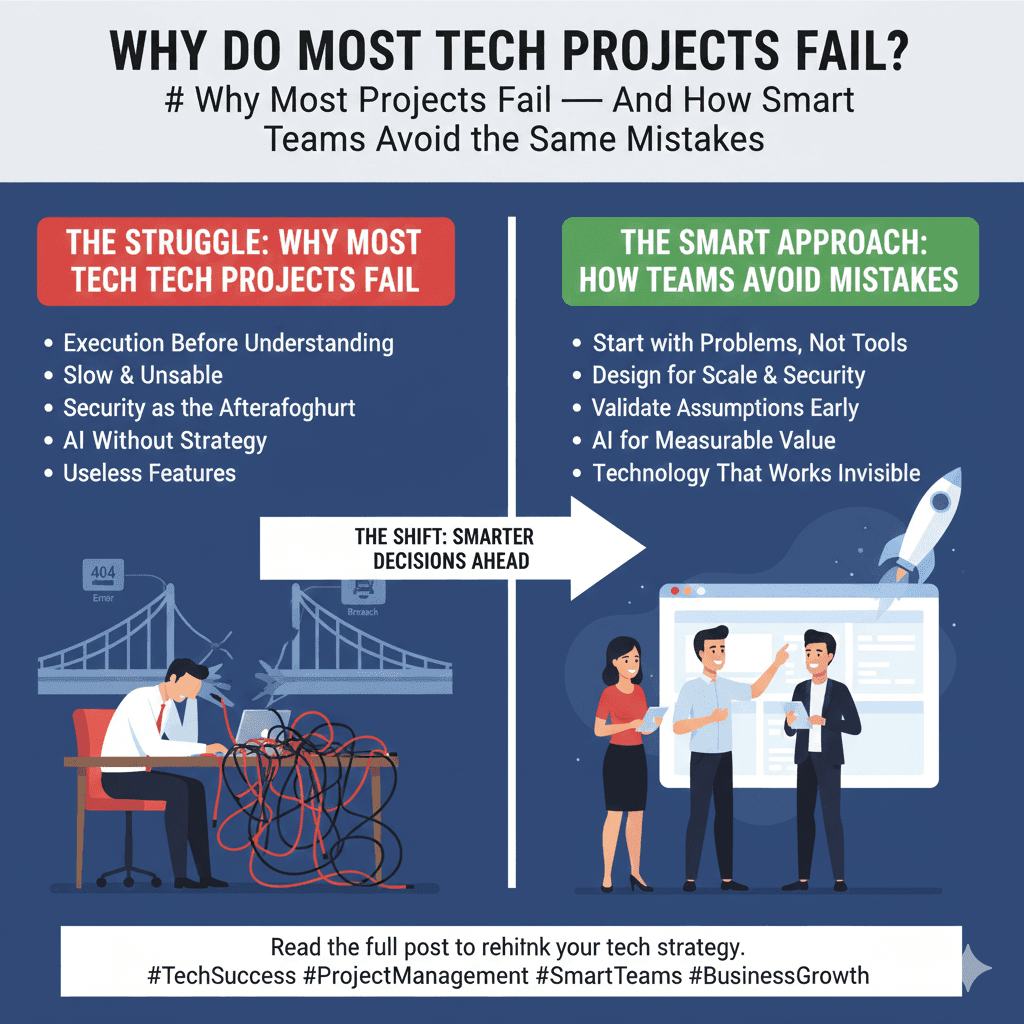
Why Most Tech Projects Fail — And How Smart Teams Avoid the Same Mistakes
Technology is supposed to make life easier.
Yet for many businesses, it becomes the most frustrating part of growth.
Slow websites.
Unstable systems.
Security issues discovered too late.
Features that look good but solve nothing.
The problem usually isn’t the technology itself.
It’s how decisions were made before the first line of code was written.
The Real Reason Tech Projects Struggle
Most tech projects don’t fail because developers lack skill.
They fail because:
- Business goals weren’t clearly translated into technical requirements
- Scalability wasn’t considered early
- Security was treated as an afterthought
- New tools (especially AI) were added without a real use case
In short, execution happened before understanding.
Common Problems We See in Growing Businesses
1. Performance Issues That Hurt Trust
A slow website doesn’t just affect SEO.
It affects credibility.
Users assume:
- Slow = unreliable
- Broken UI = unprofessional
- Downtime = unsafe
Performance is not a “nice-to-have”.
It’s a business requirement.
2. Security Handled Too Late
Many companies only think about security after something goes wrong.
By then:
- Data may already be exposed
- Trust is damaged
- Fixes become expensive
Modern systems must be designed with security in mind from day one — not patched later.
3. Features Built Without User Reality
A feature that isn’t used is a cost, not an asset.
We often see products filled with:
- Complex dashboards nobody understands
- Automations users didn’t ask for
- AI features added just to sound modern
Technology should follow user behavior, not trends.
4. AI Added Without Strategy
AI is powerful — but only when used correctly.
Without a clear plan:
- AI outputs become unreliable
- Decisions are made on flawed data
- Teams lose confidence in the system
AI should support human decisions, not replace thinking.
What Smart Teams Do Differently
Successful teams approach technology differently.
They:
- Start with problems, not tools
- Validate assumptions early
- Design for scale, even when small
- Treat security and performance as core features
- Use AI where it creates measurable value
This mindset saves months of rework and long-term cost.
Where We Come In
Our role isn’t just to build websites or systems.
It’s to solve technical problems before they become business problems.
We help teams:
- Identify real technical bottlenecks
- Improve performance and reliability
- Build secure, scalable platforms
- Use AI responsibly and effectively
The goal is simple:
Technology that works quietly in the background while your business grows.
Final Thought
Good technology feels invisible.
Bad technology demands attention every day.
If your current setup feels harder than it should be,
that’s a signal — not a failure.
The right solution usually isn’t rebuilding everything.
It’s making smarter decisions moving forward.
If you’re rethinking your tech strategy, performance, or security, start with the problem — not the tool.